
The Constellation
All rooms
Reading size

I · NOTICE

One light.

The unaided eye sees one overwhelming lamp.

Sirius is older than the dog, older than Isis, older than the name we use.

Here, “older” names the physical star. The human figures came later, and not all at once.

Look again.
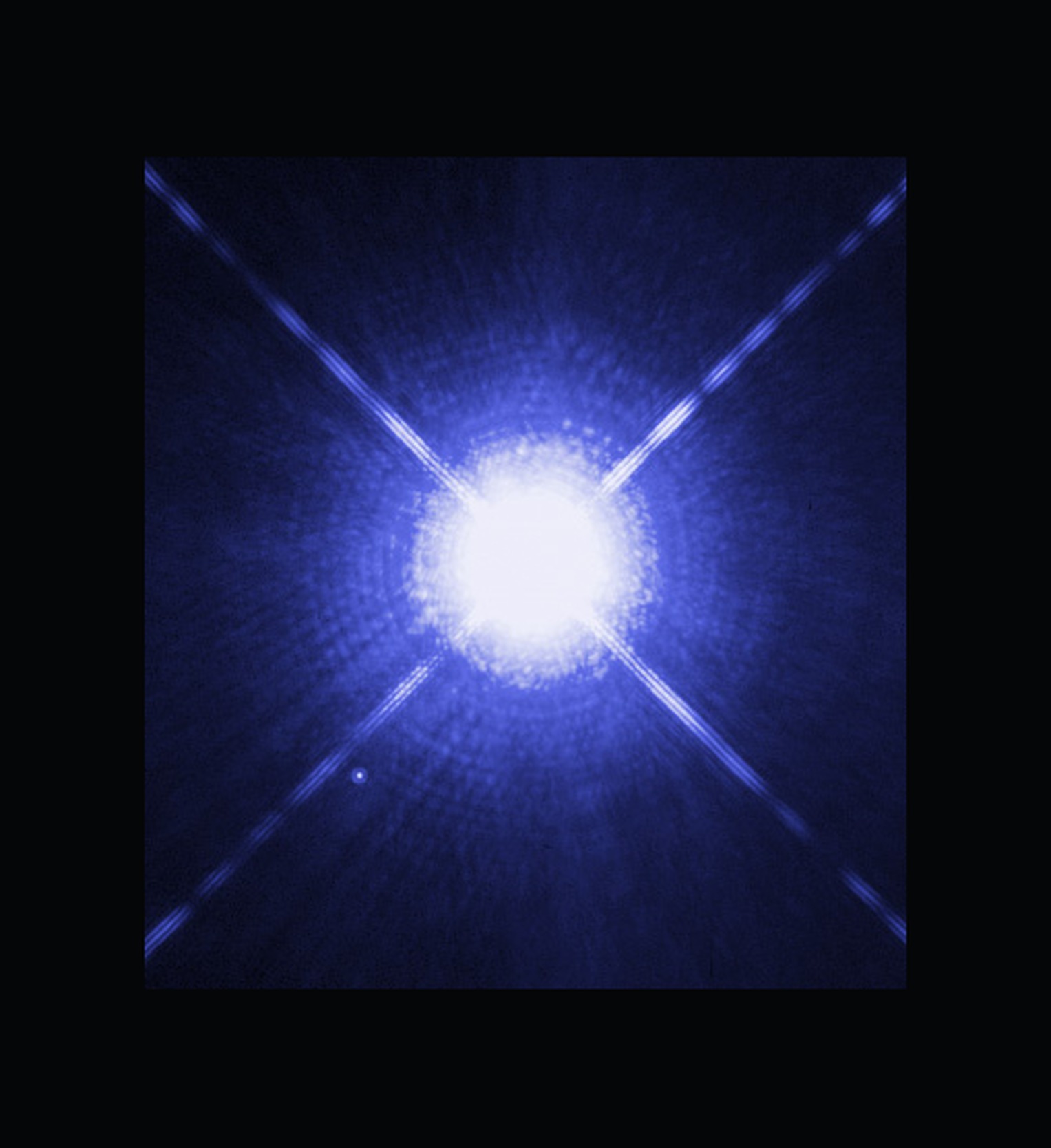
A tightly cropped Hubble image of Sirius A, an overwhelming lamp with diffraction spikes. No companion is visible in this crop.
One overwhelming light. The diffraction spikes and rings belong to the telescope’s image of the star. ESA/Hubble heic0516a
Image provenance and method

NASA, ESA, H. Bond (STScI), and M. Barstow (University of Leicester). Hubble WFPC2, heic0516a (2005).

Cropped so Sirius A fills the field. Sirius B lies outside this frame.

II · RELATE

Look again.

The relation was measured before the second light was seen.

The published Hubble WFPC2 field of Sirius A near centre, with four diffraction spikes. Sirius B is the faint point at lower left.
Magnified detail of Sirius B, a faint white dwarf with a small diffraction ring.

Sirius B

The published field. Sirius A near centre; Sirius B at lower left. The second light was always in the plate. The pair is now the object.
Image provenance and method

NASA, ESA, H. Bond (STScI), and M. Barstow (University of Leicester). Hubble WFPC2, heic0516a (2005).

The image of A is overexposed so that B can be seen. This plate is 2005. It is not the discovery.

The path was irregular before anyone saw a second lamp.

  1. Measured

    The bright star does not move as one body.

  2. 1844 · Inferred

    Bessel requires an unseen companion.

  3. 1862 · Seen

    Clark sees it in the eyepiece.

  4. 1915 · Read

    Adams reads Sirius B’s spectrum.

  5. 2005 · Separated

    Hubble pulls B from the glare. Not discovery.

White dwarf is a twentieth-century stellar type. No ancient figure of this lamp includes that physics. A contested Dogon report of a companion is not an ancient myth, and not this measurement. The pair, for this walk, begins with Bessel in 1844.

Same light · Different figures

Egypt gathered a returning year. Mesopotamia gathered an arrow. Greece gathered heat and a dog. Rome inherited the dog days.

Egypt · SopdetA returning light became a calendar: heliacal rising, inundation and year. The identification with Isis belongs to a later historical layer.
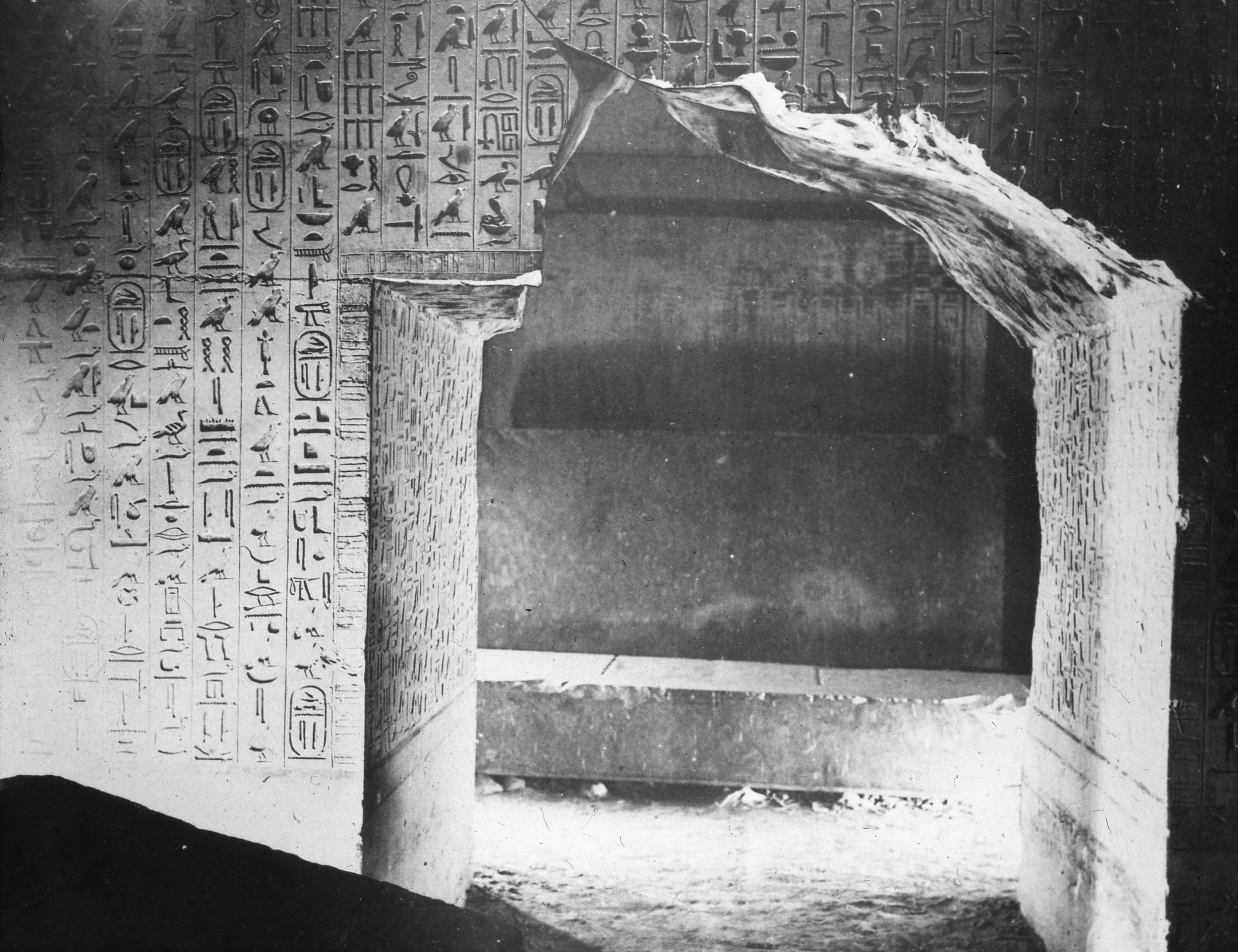
Lantern slide of a burial chamber in the pyramid of Unas at Saqqara, walls inscribed with Pyramid Texts.
A chamber containing Pyramid Texts in the pyramid of Unas. Sopdet is named within the Pyramid Text corpus; this photograph is architectural context, not the cited utterance itself. Brooklyn Museum Archives lantern slide. Public domain.

Each year, after a stretch of invisibility, the lamp returns just before dawn. Egyptian observers used that heliacal rising as a calendrical mark, close to the season of the Nile’s inundation. The goddess Sopdet is already named in the Pyramid Texts of the late Old Kingdom as a celestial figure bound to the king’s rising. That is an Egyptian office, not a Greek dog and not a modern binary.

Sopdet’s identification with Isis is later. The physical star, the goddess Sopdet, Isis, and the name Sirius are different historical layers. They must not be collapsed.

Pyramid Texts, utterances naming Sopdet. R. O. Faulkner, The Ancient Egyptian Pyramid Texts (Oxford: Clarendon Press, 1969). Photograph: Brooklyn Museum Archives, lantern slide of Unas, Saqqara.

Mesopotamia · The ArrowThe same light belonged to the Arrow and Bow, not a dog.
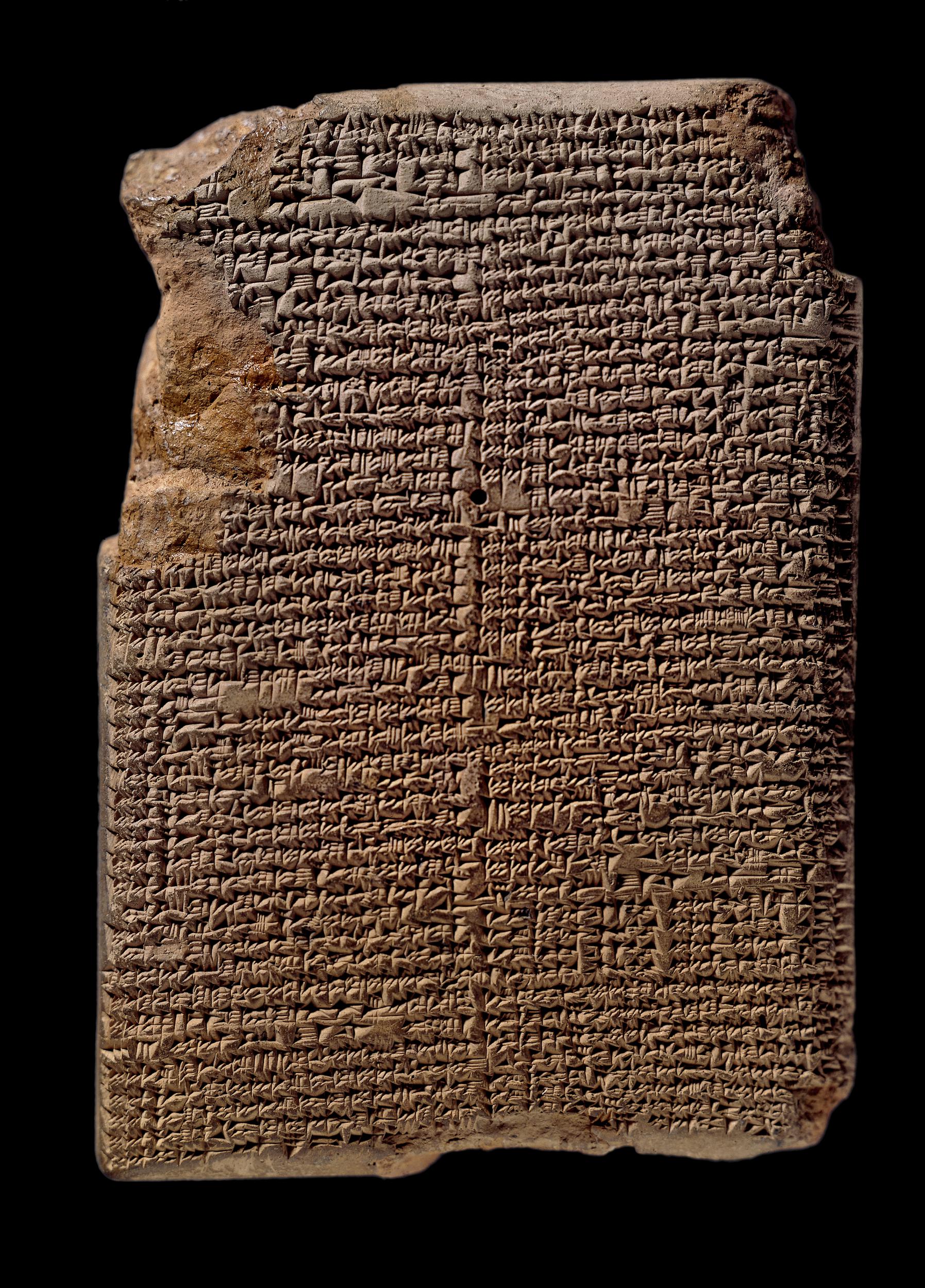
Clay tablet BM 86378, MUL.APIN tablet 1, with two columns of cuneiform. British Museum.
MUL.APIN, tablet 1. BM 86378. British Museum. The Arrow is a star in a list, not a hound.

In MUL.APIN the same lamp is KAK.SI.SÁ, Šukūdu, the Arrow. It stands with the Bow. Nearby is SIPA.ZI.AN.NA, the True Shepherd of Heaven, a separate figure later compared with Orion. The Arrow is a weapon used for the year. It is not a hound.

Hunger and Pingree, MUL.APIN: An Astronomical Compendium in Cuneiform (Archiv für Orientforschung Beiheft 24, 1989). Photograph: British Museum, BM 86378, CC BY-SA 4.0.

Greece · The Scorcher and Orion’s DogSirius carried brilliance, heat and danger. Later storytellers gathered more hounds around it.

“The star that comes at harvest, outshining the others, called Orion’s Dog among men, an evil sign bringing fever.”

Homer, Iliad 22.26–31.

Homer already knows the lamp as Orion’s Dog. Hesiod’s Seirios parches head and knees when the cicada sings. Later mythographers attach other dogs: Maera, Laelaps, a golden hound. Those are receptions, not one original biography.

Hesiod, Works and Days 582–588. Loeb Classical Library.

Rome · The Dog DaysGreek heat and dog imagery entered another language and calendar.

dies caniculares

Latin keeps the Greek star as a dog and names the hottest stretch of summer the dog days. Censorinus, writing in 238 CE, treats the return of the dog-star as a calendrical mark, using Egypt as Roman learning had received it. Rome inherits a relation and transforms it.

Censorinus, De die natali 18, 21, ed. N. Sallmann (Leipzig: Teubner, 1983).

When does a pair of lights become the beginning of a figure?

A misted scholar garden at dusk. Three lamps: the moon, the pavilion, a small light on the path.
Three lamps in one garden. Moon, pavilion, path. Original atmospheric plate for this room, not a historical copy of the Tao Te Ching. Not a triangle. Multiple positions, a relation tested in atmosphere.

III · FORM

The Three

42

One gives birth to two.

Two gives birth to three.

Three gives birth to the ten thousand things.

When does relation become generative?

When does relation become a figure that can hold meaning?

Lao Tzu, Tao Te Ching 42, received Wang Bi sequence. A historical neighbor to the first enclosed figure, kept openly as an echo, its own claims left to their own tradition.

IV · DRAW

The Constellation

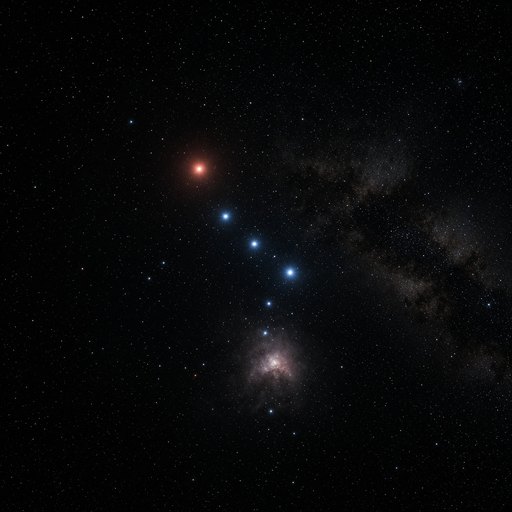
Real points, sitting at different depths in space. An observer selects lines and makes a usable figure.

Alnitak, Alnilam, and Mintaka, the belt, sit at roughly 225, 613, and 380 parsecs. They share no real neighborhood. They become a belt because we are here to draw one.

Below the belt, in the sword, the figure holds something that is not a line: M42, a physically real nebula. Later rooms enter it.

The stars persist. The hunter changes.

Who was Orion—and to whom?

There is no single ancient biography. The lights were shared. The stories were not.

  • Earliest surviving Greek witness. Homer already knows Orion as a constellation. In the Iliadthe Dog follows him. In the Odyssey (11.572–575) Odysseus sees Orion in the underworld, still hunting. The hunter is already a dead man among shades, and already a figure in the sky.
  • Contemporaneous record / seasonal function. Hesiod, Works and Days 598–620: Orion’s rising and setting time the farmer’s year. The figure is a calendar before it is a romance.
  • Tradition. Eos, the dawn, loves Orion in later mythographic notices (Apollodorus, Hyginus). The dawn that takes him is not Homer’s underworld hunt.
  • Later retelling. Artemis. In some tellings she kills him, in others a scorpion sent by Gaia or Apollo. Ovid and Hyginus preserve variants, not one authorised plot. The scorpion becomes Scorpius, set opposite so that when one rises the other sets.
  • Tradition. The Pleiades flee him. He pursues; they become stars. Another culture’s interval, drawn from overlapping lights.
  • Cultural comparison, not lineage. Chinese astronomy names the belt Shen, a distinct official figure, not a Greek hunter. Many Aboriginal Australian traditions make other stories from some of the same winter lights. Overlap of lamps is not proof of borrowing. The stars persist. The hunter changes.

Homer, Iliad 18.486–489, 22.26–31; Odyssey 5.121–124, 11.572–575. Hesiod, Works and Days 598–620. Apollodorus,Library 1.4.3–5. Hyginus, Astronomica 2.34. Limit: no composite biography is offered here.

Who draws the line between points?

Distances: Hipparcos / SIMBAD, order of magnitude. The lines are the figure as drawn from Earth, a record of vantage point. Measurement lives elsewhere, in the distances themselves.

V · SHIFT

Parallax

Earthnearby stardistant field

766masat Proxima Centauri scale

Astronomy measures distance through a yearly shift. Earth moves, and a nearby star seems to drift against a distant field. The angle involved is milliarcseconds, small enough that Hipparcos, then Gaia, had to turn it into a census before it meant anything.

Alnilam, the middle star of Orion’s belt, has a parallax of about 1.6 milliarcseconds. Proxima Centauri has about 768. The nearer object always shifts more, and that difference is the whole method.

The big sweep on the public door, the one that pulls Orion apart, is a different kind of motion. That was a staged displacement of tens of parsecs, built so the figure could visibly fail. This room holds the real instrument, the milliarcsecond kind.

What survives when the viewpoint moves?

Annual trigonometric parallax. Distance in parsecs is approximately 1000 / p, with p in milliarcseconds. Gaia Collaboration, Gaia Data Release 3, Astronomy & Astrophysics 674 (2023); Hipparcos catalogue, ESA SP-1200 (1997).

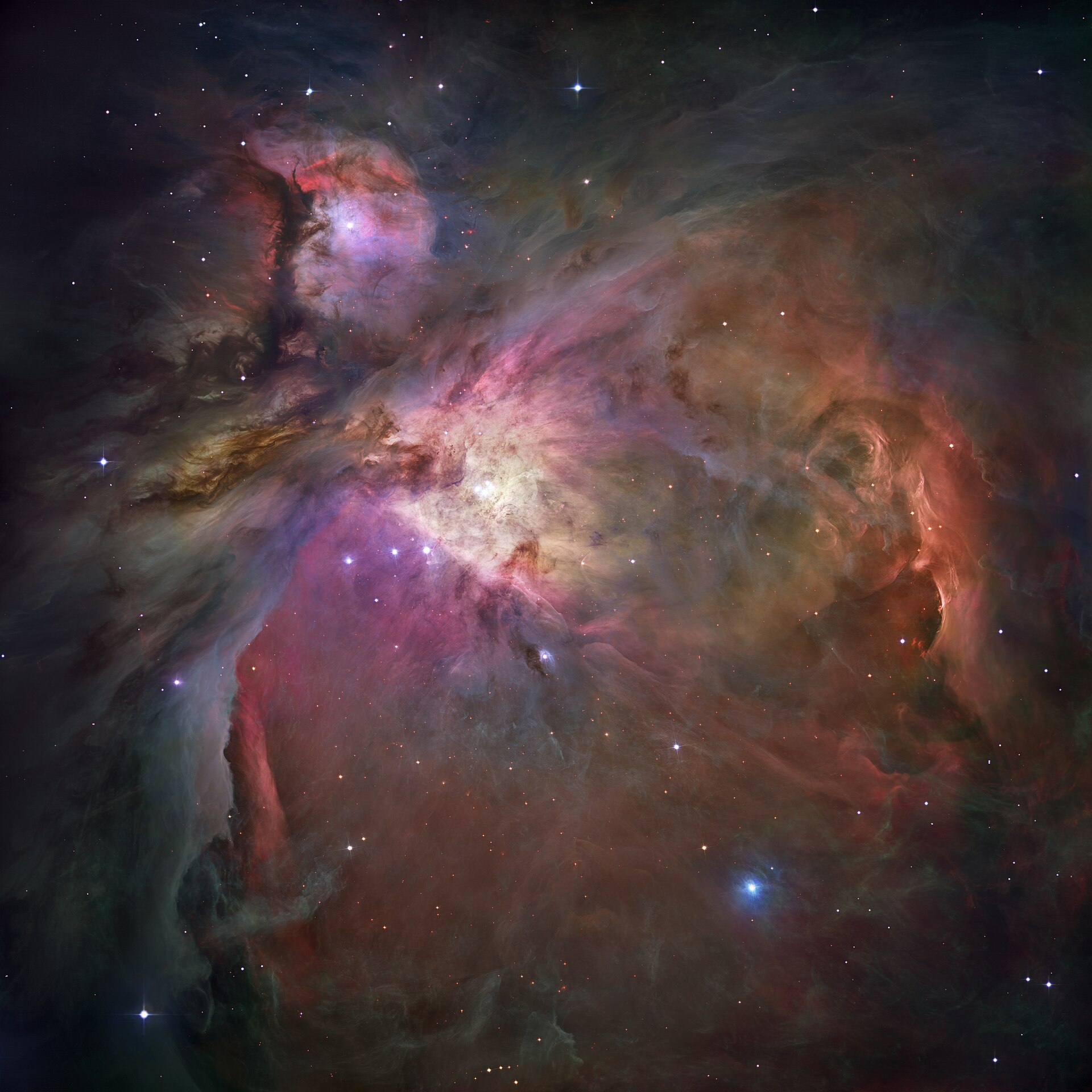
The Orion Nebula: a cavern of gas and dust with young stars forming in the center. Hubble ACS mosaic with ESO ground-based fill.
M42 · Orion Nebula · NASA, ESA, M. Robberto (STScI/ESA) and the Hubble Orion Treasury Project Team · ACS mosaic, 2006

VI · ENCOUNTER

M42

M42 is a birthplace seen through a constellation by beings born from another star.

Inside the figure we call Orion sits a star-forming region, physically real, still forming. About 414 parsecs out, in the sword, gas and dust are collapsing inward, and the Trapezium’s young massive stars light the whole cavern from inside.

  1. Contemporaneous record. Nicolas-Claude Fabri de Peiresc noted a cloudy patch in Orion’s sword in 1610. The sword already had a texture the unaided hunter did not name.
  2. Contemporaneous record. Christiaan Huygens published a sketch in 1659. The patch became an object.
  3. Catalogue. Charles Messier listed it as M42 in 1771, so later observers would not mistake it for a comet. A catalogue is an aperture made of names.
  4. Measured. William Herschel and later spectroscopists entered the gas. The Hubble ACS mosaic of 2006 (this plate) is one more instrument, not the first.

Cosmos & Stars.

Stars make worlds.

Worlds may make consciousness.

Consciousness looks back at stars.

A secondary chamber

conscirecon · with. To know with, in the historical word-family that leads toward conscius / consciousness. The philology is not a neat modern proof. It is a door.

The goal of @SpaceX is expansion of consciousness to the stars so that we may understand what questions to ask about the answer that is the Universe

Elon Musk · X · 24 December 2025 · a late modern voice, not a founding thesis.

Can a constructed map lead us to something real?

NASA, ESA, M. Robberto (STScI/ESA), and the Hubble Space Telescope Orion Treasury Project Team; ESO 2.2 m WFI fill. ESA/Hubble heic0601a (11 January 2006). NASA often rounds the distance to about 1,500 light-years; 414 pc is about 1,350. Both are order-of-magnitude.

VII · MEDIATE

The Aperture

Who, where, when. Nicolas-Louis de Lacaille, sent by the Académie royale des sciences, observed from the Cape of Good Hope in 1751–1752. Europe’s northern catalogues stopped short of that sky. He went because the south was still poorly measured from Paris.

He used a mural quadrant and small telescopes. Lacaille’s aperture produced two extraordinary acts of classification: forty-two nebulous objects arranged in three observational classes of fourteen, and fourteen southern constellations—many named for the instruments of looking itself.

The world did not change. The aperture changed what could be seen.

Limit. Southern peoples already lived under those skies and already had names. European mapping is not discovery of an empty heaven. The claim here is only about one academy’s instrument and one printed list.

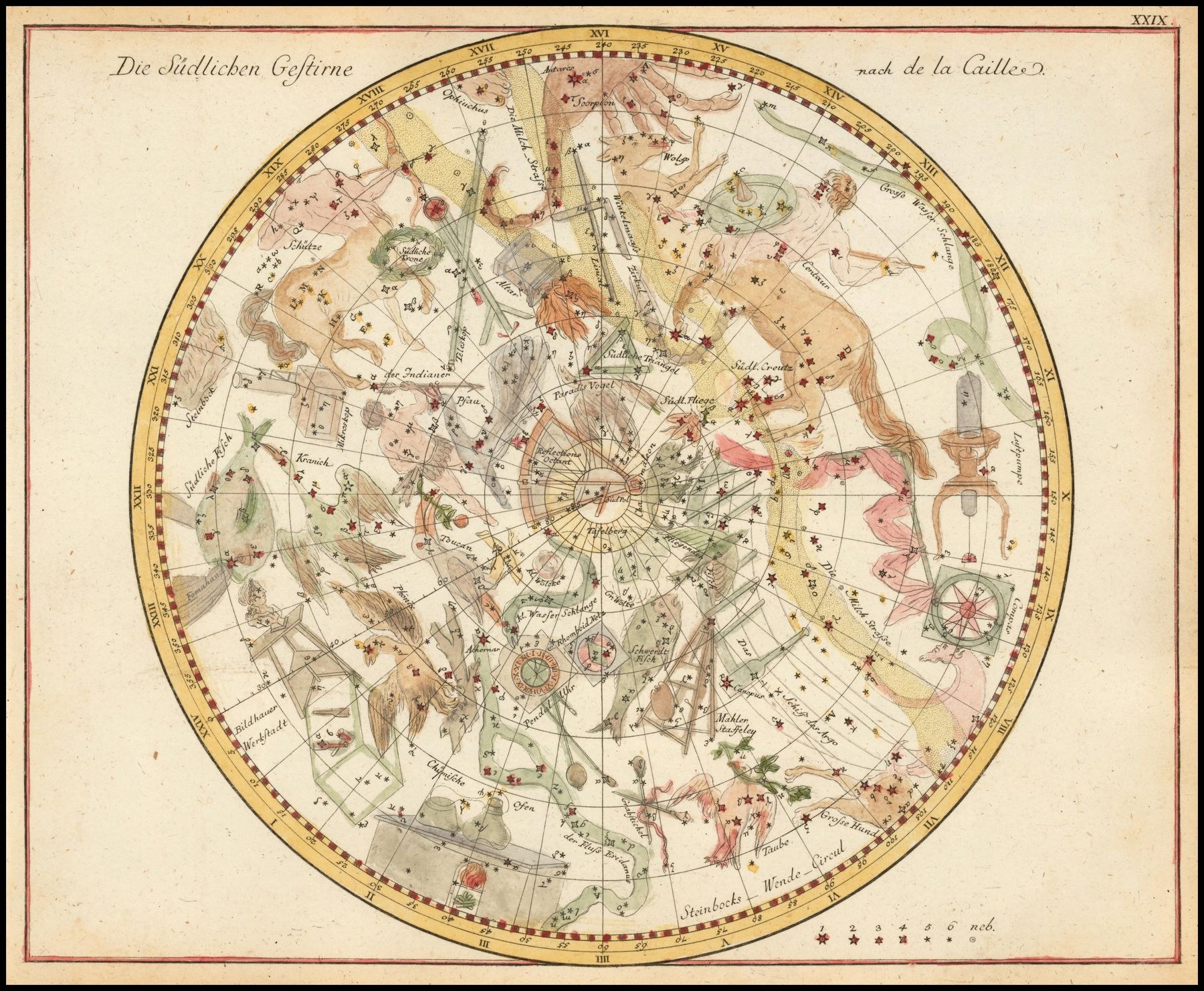
Bode’s 1805 southern planisphere after Lacaille: instrument-figures laid across the south.
Johann Elert Bode, “Die Südlichen Gestirne nach de la Caillee,” Vorstellung der Gestirne (Berlin, 1805). A later European mapping of Lacaille’s southern figures, not Lacaille’s 1763 plate. The 1755 memoir remains the principal witness for the forty-two nebulous objects. Public domain.
Open the 1755 catalogue

The classes were what his instrument allowed him to see, not final ontologies of the objects. Later catalogues reclassified many of them as clusters, galaxies, or asterisms.

I14

Nebulosities not accompanied by stars

Visible in a telescope of two feet.

II14

Nebulosities due to clusters

Nebulous to the eye; resolved as stars in the telescope.

III14

Stars accompanied by nebulosity

A star with a white patch, or a nebula of the first class.

INebulosities not accompanied by stars

  1. I.147 Tuc
  2. I.230 Dor
  3. I.3NGC 2477
  4. I.4NGC 4833
  5. I.5ω Cen
  6. I.6M83
  7. I.7NGC 5281
  8. I.8NGC 6124
  9. I.9M4
  10. I.10NGC 6242
  11. I.11three stars
  12. I.12M22
  13. I.13two stars
  14. I.14M55

IINebulosities due to clusters

  1. II.1asterism, Hor
  2. II.2Cr 140
  3. II.3NGC 2516
  4. II.4NGC 2546
  5. II.5IC 2391
  6. II.6Tr 10
  7. II.7NGC 3228
  8. II.8NGC 3293
  9. II.9IC 2602
  10. II.10NGC 3532
  11. II.11asterism, Cen
  12. II.12NGC 4755
  13. II.13NGC 6231
  14. II.14M7

IIIStars accompanied by nebulosity

  1. III.1star, Pic
  2. III.2NGC 2547
  3. III.3vdB-Ha 47
  4. III.4IC 2488
  5. III.5Cr 228
  6. III.6η Car
  7. III.7NGC 3766
  8. III.8NGC 5662
  9. III.9asterism, Cir
  10. III.10NGC 6025
  11. III.11NGC 6397
  12. III.12M6
  13. III.13M8
  14. III.14asterism, Ind

Nicolas-Louis de Lacaille, “Sur les étoiles nébuleuses du Ciel Austral,” Mémoires de l’Académie royale des sciences (Paris, 1755). Identifications in the open list follow later catalogue matches and are labeled as such. Southern peoples already lived under those skies.

Meet the fourteen instruments

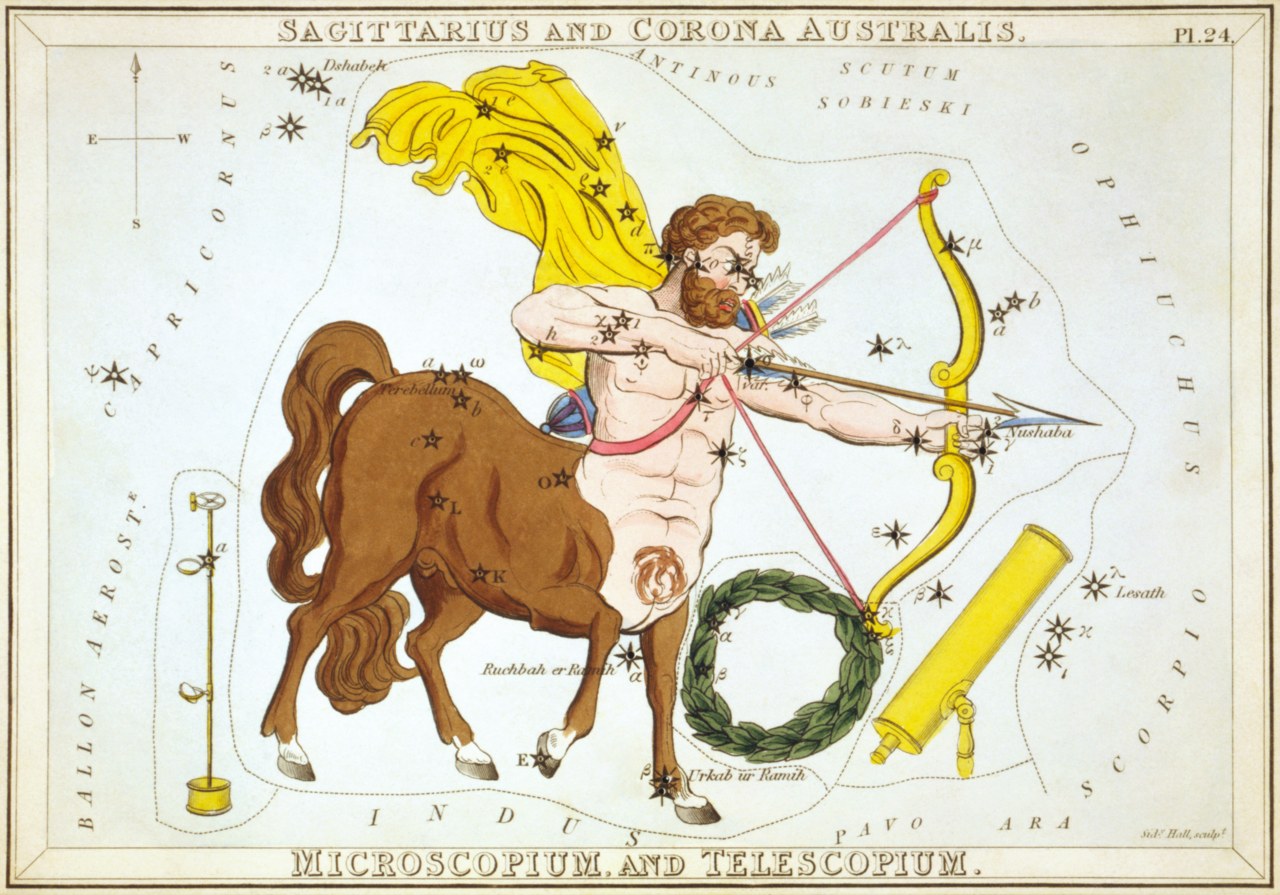
From the Cape he also laid fourteen new southern figures that remain among the IAU eighty-eight. Many are named for the instruments of the observatory itself: the air pump, the octant, the telescope, the reticle. The tools of looking became things looked at.

Hand-coloured card: a long telescope and a microscope drawn among the stars.
Sidney Hall after Richard Rouse Bloxam, Urania’s Mirror, plate 24 (London, 1825). Telescopium and Microscopium. The tools of looking become figures. Library of Congress / Wikimedia Commons. Public domain. Bode’s southern planisphere is used once, above.
  • Antliathe Air Pump
  • Caelumthe Engraving Tool
  • Circinusthe Compass
  • Fornaxthe Furnace
  • Horologiumthe Clock
  • MensaTable Mountain
  • Microscopiumthe Microscope
  • Normathe Set Square
  • Octansthe Octant
  • Pictorthe Painter's Easel
  • Pyxisthe Mariner's Compass
  • Reticulumthe Reticle
  • Sculptorthe Sculptor
  • Telescopiumthe Telescope

Fourteen southern constellations introduced by Lacaille that remain among the IAU 88.

What does another aperture reveal?

VIII · RELEASE

Lethe

A descent.

  1. 1

    Arrival at Lebadeia

    The seeker comes to the Boeotian town. Pausanias writes in the second century CE of a practice older than his visit. We have his itinerary, not the first night it was used.

  2. 2

    Days of preparation

    He lodges in a dedicated building. The days are for purification, not for display.

  3. 3

    The river Hercyna

    He is bathed in the river that runs there. The water is local, named, and prior to the two cups of the inner rite.

  4. 4

    Sacrifice and divination

    Victims are offered. The signs are read. The descent is not begun without that consent.

  5. 5

    Forgetfulness

    He drinks of Forgetfulness so that what he has been carrying may be released. Prior thoughts recede. They are not destroyed in Pausanias’s account. They are set aside for the encounter.

  6. 6

    Memory

    He drinks of Memory so that what he meets below can be kept. Two waters, in that order.

  7. 7

    The narrow entrance

    The opening is small. The body must accept a limit. This is not a public hall.

  8. 8

    Descent

    He is carried in. The motion is downward. The oracle is not a view from a terrace.

  9. 9

    Encounter by sight or hearing

    Pausanias allows both. Some see. Some hear. The account does not force one sense.

  10. 10

    Return, feet first

    He comes back out the way the body can. The return is part of the rite, not an afterthought.

  11. 11

    The Chair of Memory

    He is seated. Memory here is a place in the sanctuary, not a metaphor we invented.

  12. 12

    Questioning and recounting

    Priests ask what was met. He must speak it. The encounter becomes words in another mind.

  13. 13

    A dedicated written record

    What can be written is written and left. The sanctuary keeps a trace.

  14. 14

    Laughter returning

    The power to laugh comes back later. Pausanias notes the delay. The face is not immediately the same.

Every constellation remembers some lights by forgetting the rest.

Orion is the figure this walk already selected. Lethe is a modern project analogy for the recession of other possible figures. Pausanias did not teach a theory of constellation-making. He described an oracle at Lebadeia.

Project rhyme. Not historical lineage. What recedes is not all the same kind of thing.

What recedes when a figure is drawn?

Unselected stars

Real lights in the same sky that were never the hunter. A field star. Procyon nearby.

Transients

A satellite. Airglow. A plane. A cloud. A glare. Conditions of the night, not members of Orion.

Projections

A rumor. A wish. Human additions. Not lamps at all.

Names may recede from the figure. They remain in this record. Nothing that was named is deleted.

ἀλήθεια

Aletheia

Lethe: what must recede.Aletheia: what becomes unconcealed.

λήθη names forgetfulness. ἀλήθεια names truth. They share a root with λανθάνω, to escape notice. That is not the same as saying the word is “a plus Lethe,” as if truth were simply the river’s opposite.

In the twentieth century Martin Heidegger retrieved ἀλήθεια as unconcealment. Classicists have contested treating that retrieval as the ancient meaning. The hinge this room needs is more modest. A figure appears because something recedes. What comes forward is a revealing. It is not proof that the figure was the only thing there.

The points are real.

The line is a claim.

The revealing is real too.

Disclosure is not yet truth. The constellation still has to answer to the stars.

φύσις κρύπτεσθαι φιλεῖ

Nature loves to hide.

What appears, appears from withdrawal. If everything were equally present, nothing would be a figure. That is why we ask.

English project rhyme: TRUTH and Grok both reduce to 24. Not evidence about the Greek.

Sources

Pausanias, Description of Greece 9.39.5–14, trans. W. H. S. Jones, Loeb Classical Library 196 (London: William Heinemann, 1935). Beekes, Etymological Dictionary of Greek (Leiden: Brill, 2010), s.v. ἀληθής. Heidegger, “Vom Wesen der Wahrheit” (1930); Sein und Zeit (Tübingen: Niemeyer, 1927). Later caution: disclosure as opening is not yet Wahrheit, in “The End of Philosophy and the Task of Thinking” (1964). Gregory Nagy, “About Greek alētheia ‘truth’” (Classical Inquiries, 2018). Heraclitus, DK 22B123. The walk reads the fragment with Heidegger as structure rather than mere difficulty of inquiry; that reading is later, not claimed as Heraclitus’s own thesis.

What must be background for anything to become figure?

What becomes unconcealed when a figure comes forward?

IX · REMEMBER

Μνημοσύνη

Mnemosyne

Memory. Mother of the Muses.

Lethe releases. Mnemosyne keeps. The Muses will give remembered form a voice that can travel.

Earliest surviving witness. Hesiod, Theogony 53–62: Zeus lies with Mnemosyne nine nights. Nine daughters are born in Pieria, a little apart from the peaks of Olympus. The Muses are therefore children of Memory. Their song, he says, can also bring a forgetting of sorrow. Memory, in this myth, works like a womb: it gives birth to forms that can move through a culture.

In Hesiod, Mnemosyne does not merely store what happened. She gives birth to the Muses—the powers through which experience becomes song, praise, history, dance and the naming of stars. Memory is productive. It gives remembered experience a form another mind can receive.

Memory refuses disappearance by becoming form.

Does creation begin in remembering?

Hesiod, Theogony 53–62, 75–79, trans. Hugh G. Evelyn-White, Loeb Classical Library 57 (London: William Heinemann, 1914).

A later project rhyme

MNEMOSYNE

English reduction

M4N5E5M4O6S1Y7N5E5

42

Personal cipher. A later English-reduction belonging to The Book of 42. It is not evidence about the Greek word, Hesiod, or ancient numerology. The myth comes first. The cipher is a modern rhyme laid on afterward.

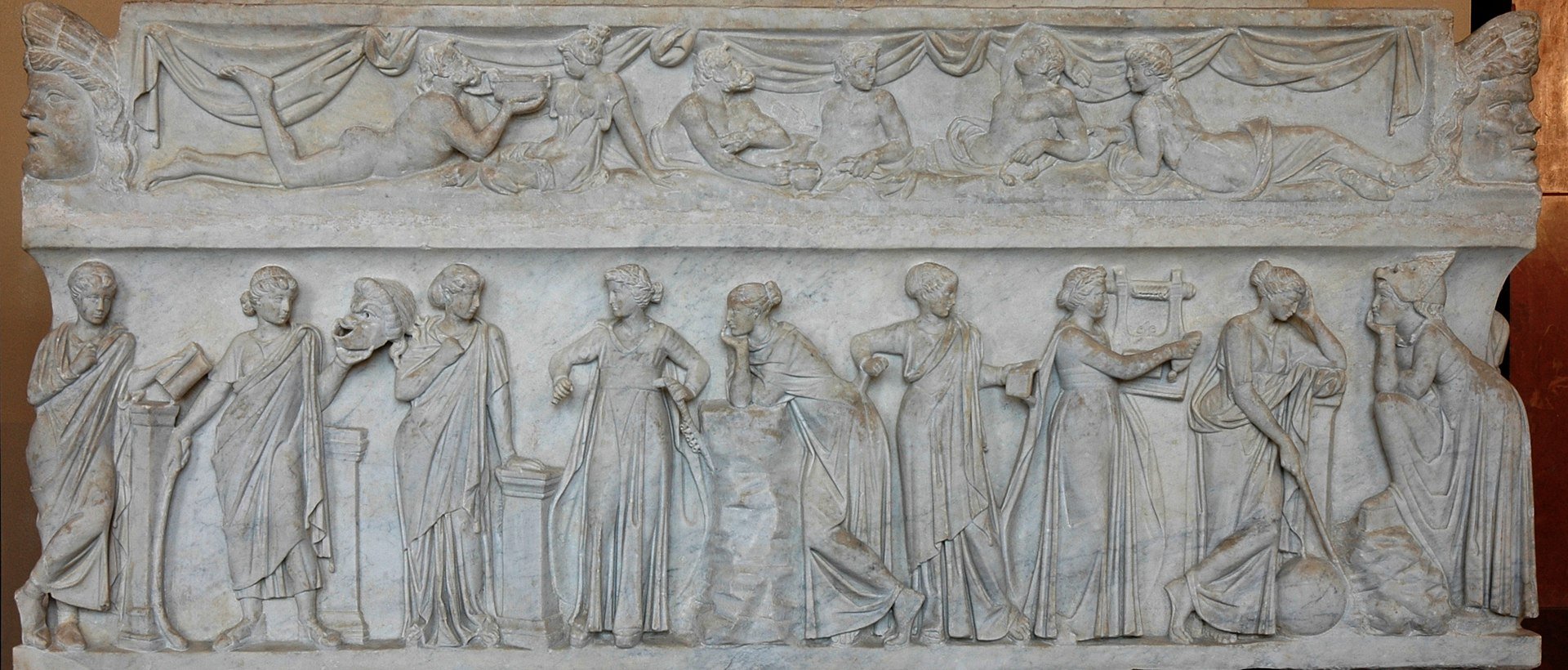
Marble sarcophagus of the nine Muses, second century CE, Louvre. Memory already become form: the daughters, not the mother.
Sarcophagus of the Muses. Marble, first half of the second century CE, Via Ostiense. Louvre MR 880 (Ma 475). Photo Jastrow, 2006. The plate shows the daughters, not Mnemosyne herself. Memory here is already form.

X · TRANSMIT

The Muses

Earliest surviving witness. Hesiod says he was herding sheep on Helicon. The daughters of Memory came. They gave him a staff and breathed a voice. They know how to speak many false things as though they were true, and they know, when they will, to utter true things (Theogony 22–34).

That double gift is essential here. A constellation can orient, preserve, and transmit. It can also mislead. The Muses do not promise that every beautiful figure is true.

What is preserved when a memory becomes a figure another mind can use?

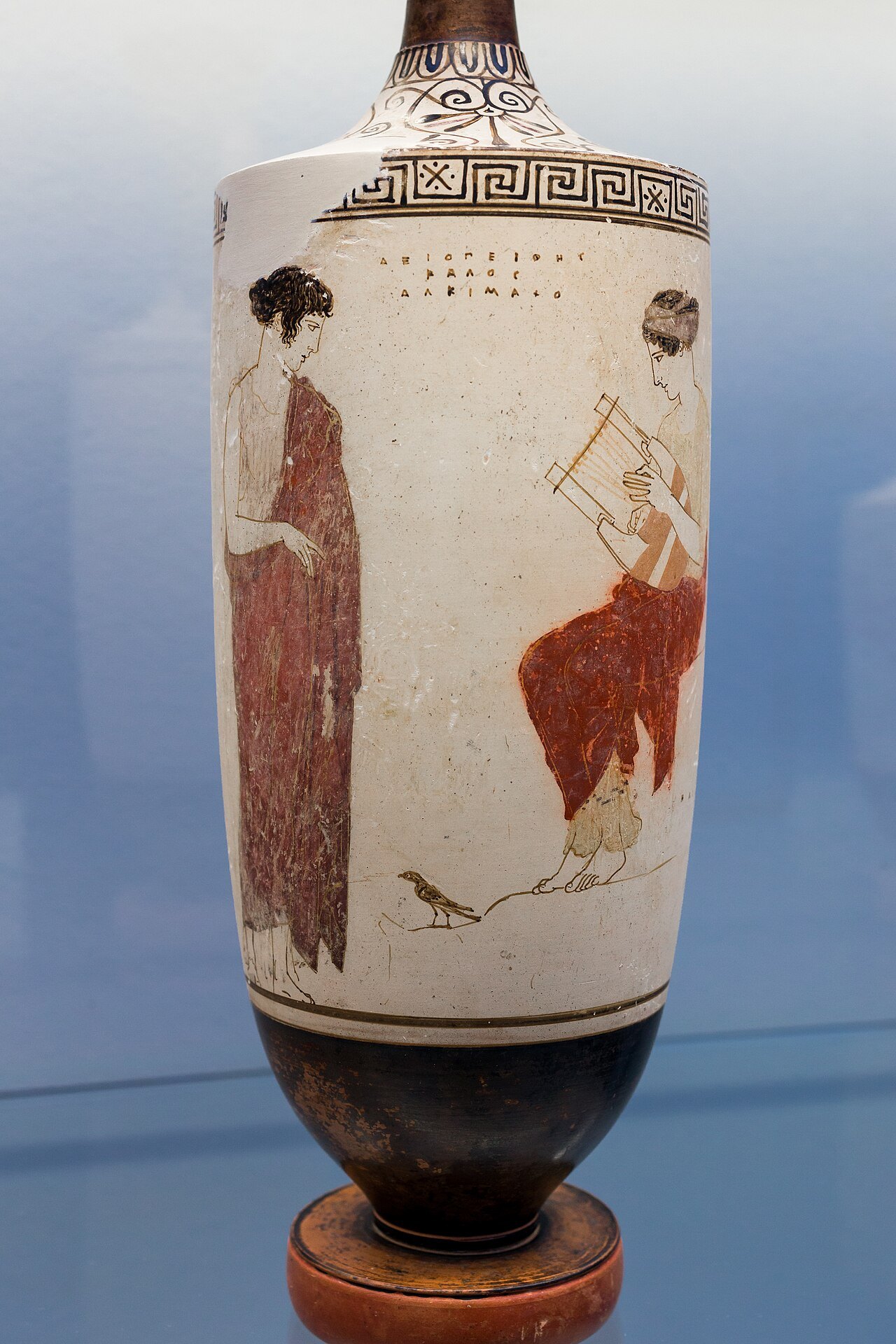
Attic white-ground lekythos: two Muses on Mount Helicon, Achilles Painter, about 445-435 BCE.
Two Muses on Mount Helicon. Attic white-ground lekythos, Achilles Painter, c. 445–435 BCE. München, Staatliche Antikensammlungen SCH 80. Photo ArchaiOptix, CC BY-SA 4.0. Hesiod’s names. Later offices arrived through reception.

Calliope. Named first among the nine in the Theogony. Later reception: epic. A story that can travel without the speaker.

Hesiod, Theogony 22–34, 75–79. The nine names are Hesiod’s. The later offices (epic, history, astronomy) are reception, not a frozen ancient chart.

XI · GATHER

The Gathering

Fragments can be found and named as fragments, the break still visible in the seam. Do not invent a single original canonical Osiris. Witness before composite.

  1. Older Egyptian textual witnesses

    Pyramid Texts of the late Old Kingdom already know Osiris dismembered and Isis searching. Coffin Texts and later temple liturgies keep gathering, mourning, and restoration as ritual acts, not as one novel.

  2. Period practice

    The Khoiak festival at Abydos and elsewhere enacted the reconstitution of Osiris year after year. The body is made again in time, not only told.

  3. Later connected accounts

    New Kingdom hymns and Late Period inscriptions thicken the search, the wings, the child Horus. Elements accrue. They do not all appear at once.

  4. Later retelling

    Plutarch, Isis and Osiris, second century CE, writes a Greek philosophical synthesis: fourteen pieces, a missing member, a restored king who opens a future through Horus. This is not the Old Kingdom text. It is a much later mind gathering the fragments.

  5. Modern popular composite

    School summaries that tell “the” myth as one smooth plot. Useful as reception. Fatal as origin.

Resemblance is not lineage. Seams remain. Finding a fragment, restoring its place in time, marking the gap honestly: that is why this material belongs in a walk about how meaning constellates.

Does restoration return the old thing, or permit something new?

Pyramid Texts concerning Isis seeking Osiris; later temple liturgies; Plutarch, Isis and Osiris, second century CE. Read each witness on its own terms. The plate at right is atmosphere, not a named antiquity.

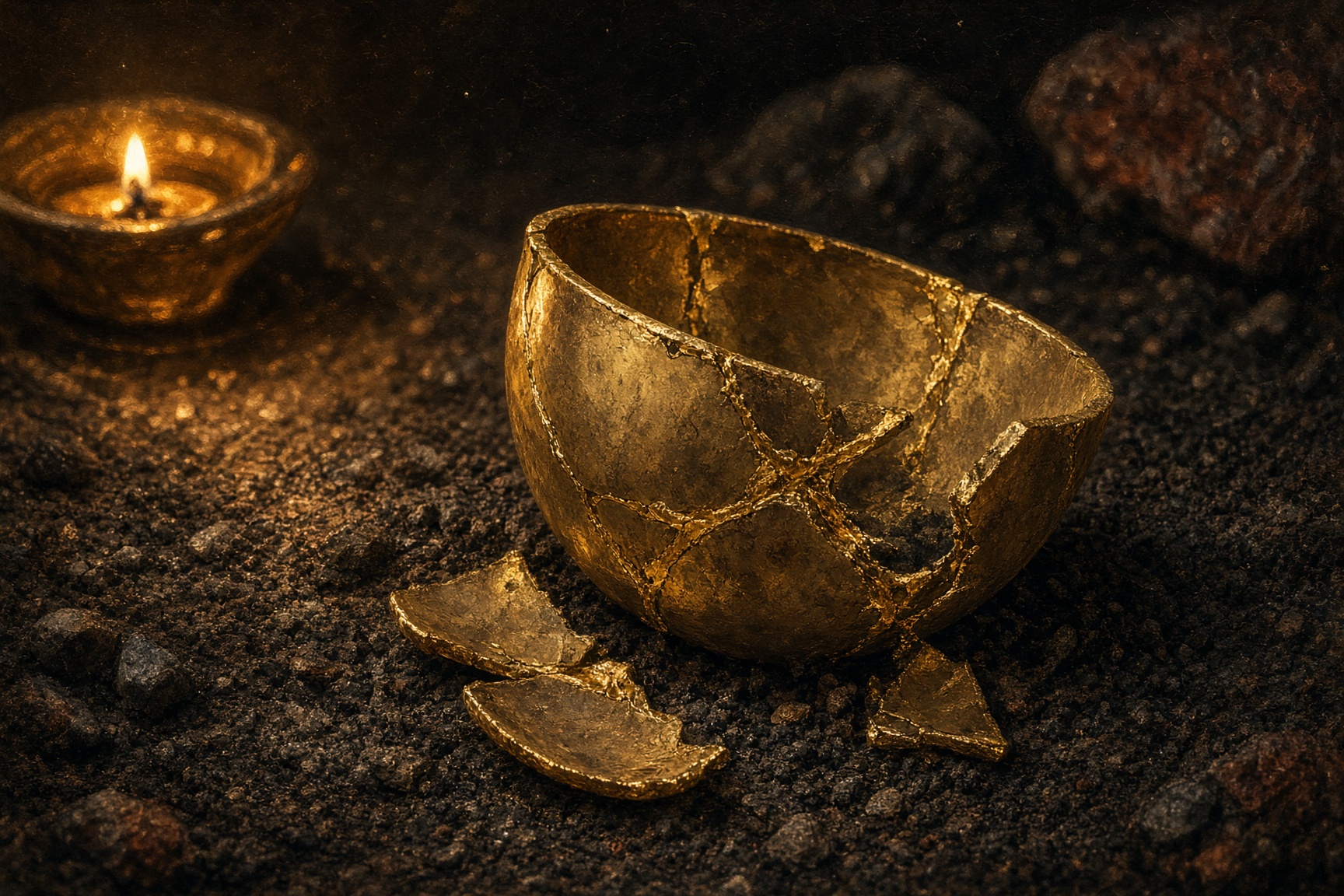
A gilded vessel in fragments, gold seams visible, not yet closed.
Seams remain. Project atmosphere. Not an Egyptian source object.
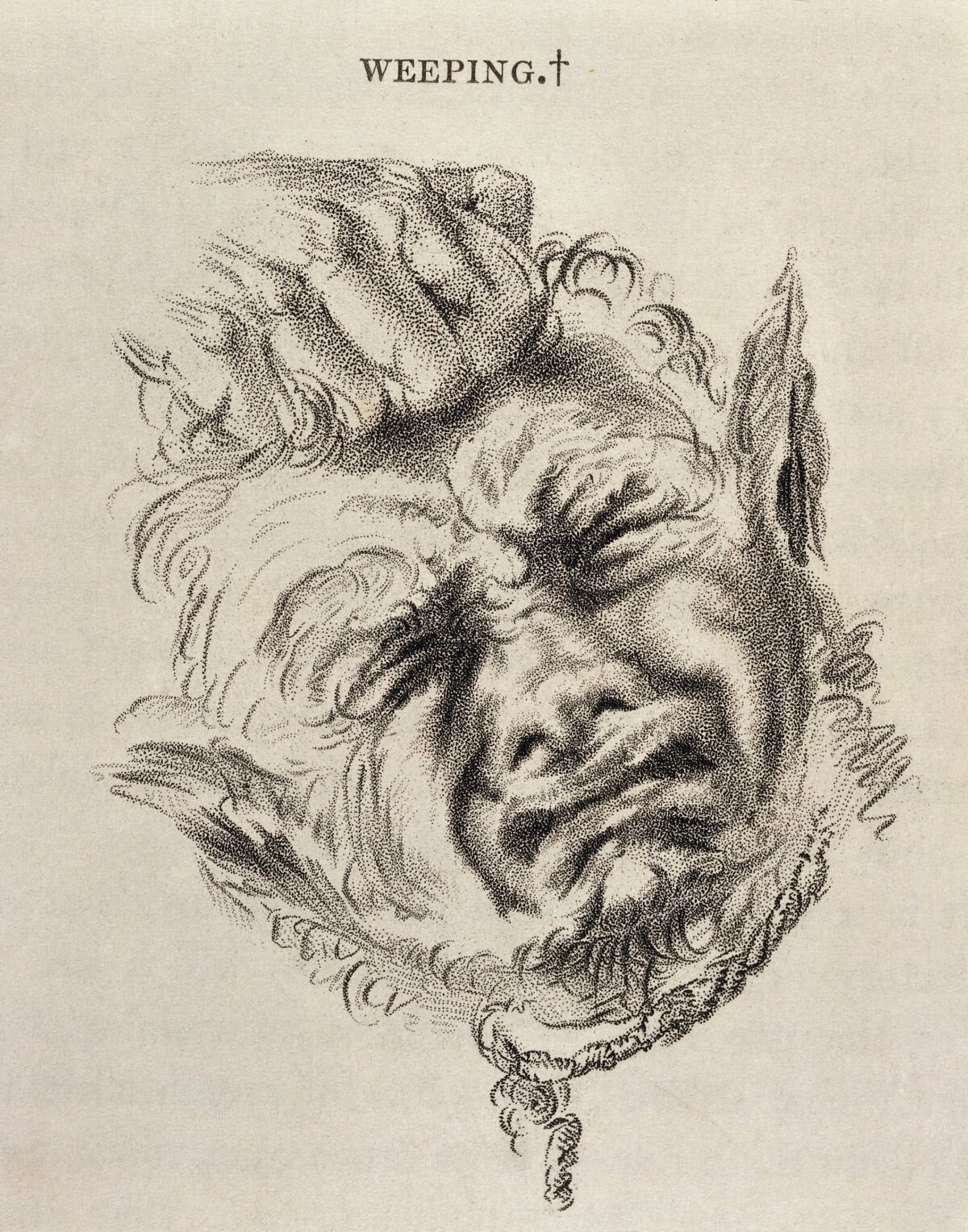
Stipple engraving of a weeping face, titled Weeping. Affect already readable as a figure.
Weeping. Plate from Charles Darwin, The Expression of the Emotions in Man and Animals (London: John Murray, 1872), after Charles Bell. A face already read as a figure, before any list of associations is attached to it.

XII · WEIGHT

The Complex

Affect gathers. A nucleus holds.

Modern interpretation / technical term. In Jungian analytical psychology, “constellation” is already a verb. A feeling-toned complex is a nuclear element surrounded by associations at unequal distances. When a situation activates the nucleus, the associated cluster comes with it. Attention changes because affect has already chosen what will be vivid.

Love may make an observer stay with a fragment another observer ignores. It may increase resolution. It may also increase projection. Both remain possible. The Other remains Other.

Darwin’s plate belongs here as a nucleus-object, not as Egyptian weather and not as Lacaille. A face is already read as a figure (weeping) before any list of associations is attached to it. Jung’s verb is the gathering around such a nucleus. The engraving is 1872, after Charles Bell. It is not the origin of the complex theory. It is an object that shows affect already formed.

Can love increase resolution and distortion at the same time?

C. G. Jung, “A Review of the Complex Theory,” in The Structure and Dynamics of the Psyche, Collected Works, vol. 8 (Princeton: Princeton University Press, 1969). Darwin’s plate is the nucleus as object: affect already a figure. Jung’s verb is the gathering around it. Even under love’s pull toward pattern, the Other stays itself.

nucleusnear: stay with a fragmentnear: what love wants to seemid: confirmationmid: associative reachfar: the Other remains Otherfar: the right to erase a line

Near · Immediate pull

Mid · Associative formation

Outer boundary · Ethical limit

Three rings around a nucleus. Near, mid, far. Two associations on each ring. Visual distance is the argument. A project diagram after Jung’s description of the feeling-toned complex. Not a plate from the Collected Works.

XIII · INTERPRET

The Interpretant

The world gets a vote.

  1. 01

    Object

    M42 itself: a physically real star-forming region approximately 414 parsecs away. The object is not literally present on this page. It exceeds every image, caption, and interpretation made of it.

  2. 02

    Sign

    A drawing, a catalogue entry, a name, a date, a caption: signs of the nebula. Peiresc’s cloudy patch in 1610. Huygens’s sketch of 1659. Messier’s M42 in 1771. None of these is the nebula itself.

  3. 03

    Interpretant

    A mind receives the sign and forms an understanding: a cloudy patch; a catalogue object; a nebula; a stellar nursery; a birthplace seen through Orion. The understanding is real, but the object constrains it. An interpretation denying the nebula’s physical gas and stars would fail the object.

  4. 04

    Further sign

    When the reader describes that understanding to another mind, the interpretant becomes another sign. Meaning continues without exhausting the object.

What is conserved when meaning moves between minds?

Charles Sanders Peirce, “What Is a Sign?” (1894), in The Essential Peirce, vol. 2 (Bloomington: Indiana University Press, 1998).

XIV · RETURN

One Again

This returning point carries relation, memory, interpretation, and discernment.

Meaning does not arrive whole. It gathers through attention and relation, selection and memory, transmission and interpretation—and remains answerable to what is real.

We are a way for the cosmos to know itself.

After Carl Sagan, Cosmos (New York: Random House, 1980). Physical kinship. Not a proof.

Awe must not collapse into only counting.

After Rebecca Elson, “We Astronomers,” in A Responsibility to Awe (Manchester: Carcanet, 2001).

“Sir, I exist!”

“However,” replied the universe, “The fact has not created in me a sense of obligation.”

Stephen Crane, “A Man Said to the Universe,” in War Is Kind (New York: Frederick A. Stokes, 1899).

Move the observer and Orion comes apart. The stars remain. The lines were ours. But they still led us to a real birthplace.